
by Brian Floyd
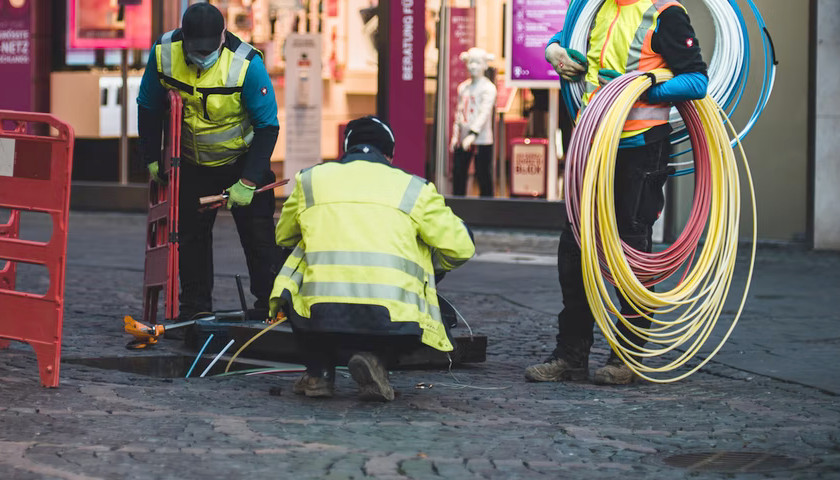
Tennessee has received $813 million in federal taxpayer money to expand broadband access across our state under the Broadband, Equity, Access and Deployment Program (BEAD). Nationwide, the federal government is dispensing nearly $43 billion across all 50 states and six territories.
When Governor Bill Lee took office in 2019, 20 percent of Tennesseans lacked high-speed broadband internet – including the Governor at his farm. A few months ago at the AI Summit in Nashville, Tennessee Economic and Community Development Commissioner and Deputy Governor Stuart McWhorter estimated that less than two percent of Tennesseans currently lack access to broadband. The gap has seriously been closed.
In a recent announcement regarding $200 million in BEAD funding, Governor Lee and Commissioner McWhorter estimate that 100% of Tennesseans will have high-speed access upon completion of these BEAD projects in 2028.
However, there is a key component that is essential to deploying broadband to the Tennesseans who still do not have access to high-speed internet. That is the ability of private providers to attach broadband fiber to electric poles in order to rapidly deploy high-speed internet to the most rural underserved parts of the state. Here in Tennessee and across the country, monopoly utility companies charge pole attachment fees to private broadband providers seeking to build out networks and expanded access to underserved areas.
The issue here is that these utility companies have not kept their poles in the best shape. Instead of charging a fair and reasonable pole attachment fee (think of it like a rental fee or lease fee), these same utility companies try to put the full cost of their deferred maintenance on to private broadband providers. This is like renting a car and the rental car company then charges you for an oil change, new tires and new brakes. That’s the equivalent of what these monopoly utility companies have been doing to private providers who want to lease their poles.
Instead of keeping their network of utility lines and poles in working order, these utility companies charge excessive “make-ready” fees before a private company can attach broadband lines to the utility pole.
This is unfair and until this year there was little that could be done to hold utility companies accountable. Thankfully, the Federal Communications Commission (FCC) issued a new ruling via its Rapid Broadband Assessment Team (RBAT). The ruling states that power companies – whose job it is to maintain poles and other equipment – cannot charge broadband providers excessive fees, including the full cost of pole replacement.
Under the FCC’s new ruling, private broadband providers are only obligated to pay any incremental cost associated with any upgrade in the poll, and not the full replacement cost.
This new path forward provides a fairer system where any company attaching a new line is only responsible for any incremental cost of the pole. The utility company must bear the costs of fixing preexisting poles in disrepair.
With more than $800 million in total BEAD funding, this FCC ruling could not have come at a better time. Tennessee policymakers must ensure that those funds are used to expand broadband. It must not be used for rent-seeking by utility companies to cover years of their delayed maintenance decisions. Those costs, under the new FCC guidance, will no longer be unfairly passed along to outside companies that had nothing to do with the long-term and previous maintenance of electric poles. They will however pay fair market rates to lease or rent space on the pole. This is both a fair and a market driven approach.
State policymakers should ensure that utilities are honest and fair in any pole attachment fees going forward. Thanks to the FCC’s February ruling, they now have clear guidance and a standard to keep utility monopolies honest.
– – –
Brian Floyd serves as a board member of The Tennessee Conservatives Coalition.




Amazingly the government has spent billions of our dollars to get broadband to everyone. That is a sad statement. How could one possibly live without access to the internet?!! I chose to live out in the sticks. Why should my counterparts in Nashville pay for my decision. I disagree that this is something to crow about.